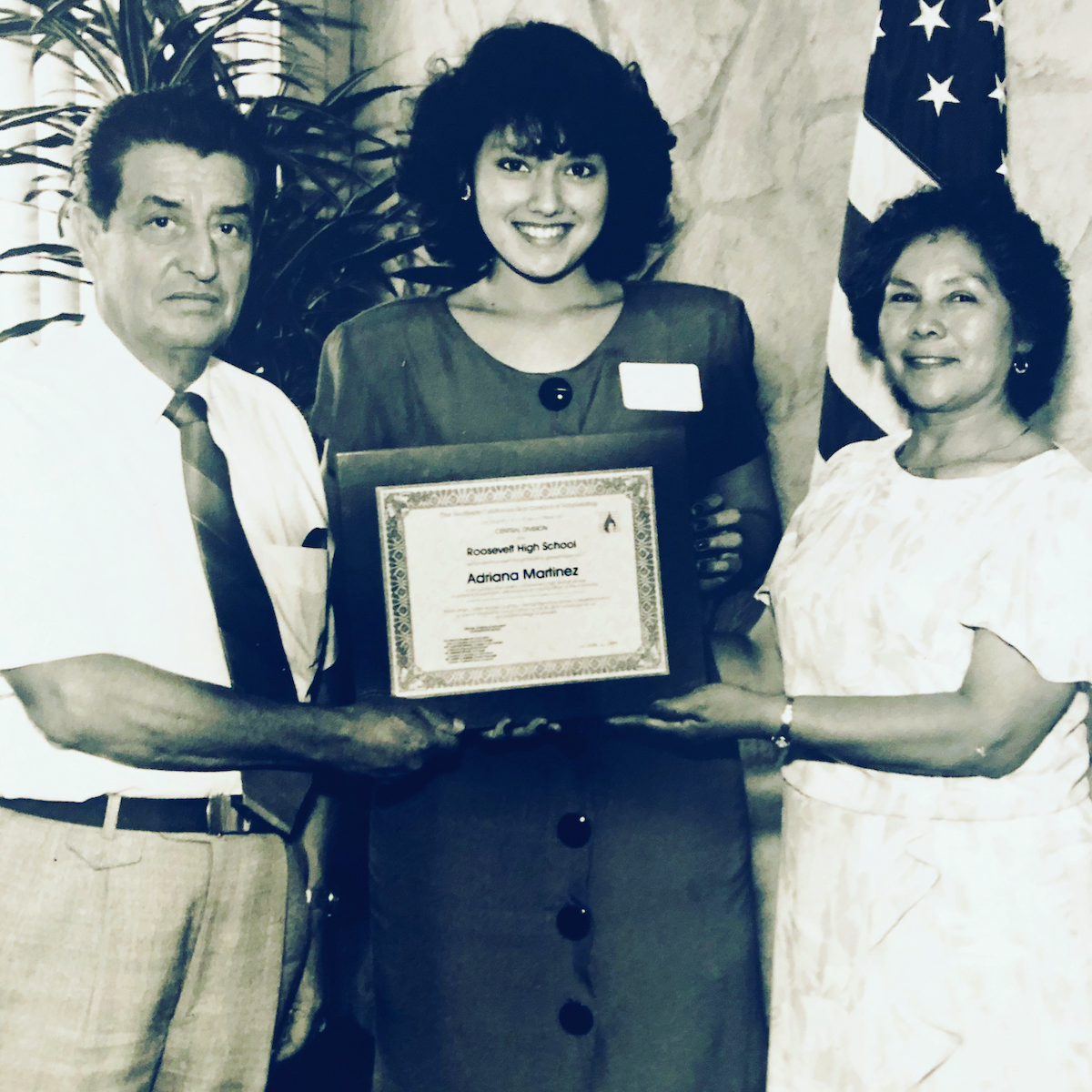
As the daughter of Mexican immigrants, I grew up in a home where nothing was wasted—not food, not time, not opportunity. I was raised in the housing projects of Boyle Heights, just east of Downtown LA. My parents worked hard and measured life in sacrifices: hours worked living paycheck to paycheck to provide for our family. My father was a laborer, including as an assembler and seasonal farm-worker, while my mom worked in the public-school cafeterias part-time and the rest of the time watched over us. I am forever grateful to them for making sure my dreams could move forward.
My parents never owned a home. When my father passed away prematurely without fulfilling his goal of moving us out of the projects, I promised myself to fulfill that goal. He died the year I graduated from college, so I knew it would take years before I could do that. My first full-time professional job in 1994 was with Congressmember Lucile Roybal-Allard on Capitol Hill in Washington, D.C. Before I earned my first paycheck, I owed my supervisor $400 for the loan he generously gave me for the downpayment on my first apartment. I was 23 years old, and it took several years of discipline, patience, and living frugally to save enough money to return to Los Angeles and buy that first house.
Years later, after earning my MBA at UCLA on a Goldman Sachs fellowship, I invested in a second home with my then fiancé, Luis. We settled in Alhambra where we would start our life together, get married, and raise our two children.
We eventually moved from Alhambra to Altadena, and it felt like a quiet victory. We had managed to buy a more spacious house with a larger back yard where our kids, then starting high school, could host friends. A house in a much greener and more peaceful neighborhood with my very own hiking trail just blocks away in the San Gabriel Valley foothills. Those hills overlooking the LA basin became a sanctuary for me, a place where I would reflect and pray. Yes, pray with gratitude for my blessings, including this tranquil neighborhood we had settled in. I felt it and would often say it out loud with arms outstretched looking up to the Heavens, “I made it. Thank you.” And I thought about my parents and everything they had done to make it possible.
At this stage in my life, I felt secure and financially stable.
Then the Eaton Fire came.
I usually worked from home. But on January 7, 2025, I went to the office because we had been warned about an imminent power outage in our neighborhood of Altadena. Citlali, our daughter, had driven off to Stanford two days prior to start Winter Quarter. Diego, our son, had spent the night at a friend’s place in Downtown LA, since he would be starting his high school community service project in nearby Boyle Heights the next morning. Luis went to the office as usual.
Neither one of us had slept much the night before due to the ferocious winds.
I was back home by 2pm to attend a Zoom meeting — I had heard our power had not gone out as expected. As I sat through the meeting, the winds howled so loudly that my colleague on the other end of the screen noticed. We ended our meeting early.
Diego was scheduled for his high school soccer practice as usual that afternoon. I wondered whether the winds were as bad in the Pico-Union area where he was. I checked the parents’ group text for updates. Nothing. I reached out to another ‘soccer mom’ who also lived in Altadena. In talking, we calmed each other over the situation; then, she asked me, “Do you follow Edgar McGregor?” I replied, “Who is that?” She went on to tell me about Edgar, a local meteorologist who had just shared an update about the situation on his Facebook page, “Altadena Weather and Climate.” The forecast was ominous. He warned of unprecedented, hurricane-like conditions, and advised Altadena residents to have an evacuation plan ready. I decided we would leave immediately. When I told Luis we should pack a bag to leave for a couple of days, he thought I was exaggerating. Nevertheless, he agreed, convinced that we’d be out of power soon as the weather conditions worsened by the minute.
It was roughly 4:30pm when I called Diego. I told him, “Don’t come home,” and to meet us in Old Town Pasadena, where Luis had booked a hotel. I packed Diego’s bag with the basics, especially soccer gear — soccer was his “life” at that time. It wasn’t even 5pm when Luis and I put three small bags into his car and drove off. I noticed the color of the sky change to a deep orange color. As we kept driving down Lake Avenue, I had a sinking feeling about leaving so much behind, including my minivan. I sensed that this could be more than a couple of days.
That afternoon I moved with an urgency and uncertainty that made me think about my parents, and made me appreciate them even more. They had shared stories about leaving things behind — their family, their home, their country, versions of themselves. My father, born in Chicago but raised in Mexico, left his hometown in Jalisco as a teenager to work the fields of Northern California in hopes of building a better life in the U.S. My mom was the second-eldest in a large family in a remote under-resourced village in Durango, Mexico, and initially migrated to Texas on a VISA as a domestic worker to help support her family. My parents were young and alone in a foreign land; it must have taken a lot of courage, strength and faith to get through that.
As threatening as things looked on January 7, 2025 in Altadena, I knew that my parents’ situation had been different and much worse. The plight of immigrants crossing borders, still today, in search of a better life is much worse. That reflection gave me strength, and faith that this threat would soon pass.
Less than an hour later, we met Diego at the hotel just three miles south. We decided to have a nice dinner after a restless day. As we enjoyed our meal, our phones started “blowing up” with texts and calls. As Diego looked at his phone, he announced, “there’s a fire in Eaton Canyon” – just two miles east of our home. As we finished dinner, I prayed that the fire would not spread to our immediate neighborhood.
As we exited the restaurant, the winds were so ferocious I felt they would sweep me off my feet! I held on tightly to Diego’s arm as we scurried to the underground parking garage and rushed into the car. The sky was blackened by smoke. Once back at the hotel, it was clear that the fire was spreading rapidly. People had fled Altadena; in the lobby, a line of people desperately hoping to book a room was long and growing.
When we got to our room and looked out the window, we saw live flames from a distance up in the hills. It appeared concentrated in the immediate Eaton Canyon area, far away from our house. Yet, I could smell smoke as the scent grew stronger by the minute. We did our best to keep out the smoke, putting towels at the base of the door. I sat at the edge of the bed and prayed silently. I had no idea nor visual of the devastation that was unfolding in our beautiful Altadena foothills that night.
The next morning, when Diego woke up, he looked at his phone and exclaimed, “oh my God!” Two of his classmates’ homes, just down the street from ours, had burned to the ground. They messaged Diego as they walked toward our house to check on it. I did not want to know. I was certain our house was gone. But then Diego announced, “Look! Our house is still standing,” as he put the phone in my face and showed me the image. Behind a huge dark grey cloud of smoke, with tall live flames visible at some distance behind it, there it was – our home. I couldn’t believe my eyes.
Diego insisted that we drive up to see the house for ourselves. I got in the car with Diego, and as he made the first right turn into Altadena, west of Lake Avenue, the first thing we saw was the charred frame of a car. As we turned left to head further north, we found ourselves surrounded by live flames about a block away to our right and to our left, and ominous darkness ahead. Diego turned on the headlights. We kept rolling up and came upon a large fallen tree blocking the road. We stopped, looked around and the only light we could see were more live flames. In that moment, I felt that our lives were in danger and we needed to turnaround and leave! As we drove away, Diego exclaimed, “It’s like an apocalypse!” We were both in shock.
We had lost track of Luis, who was in his own car also trying to drive up to the house. The fog of smoke was so dark it was hard to even see headlights. Once reunited with Luis back at the parking lot of the hotel, we were relieved to be together again. Luis and I decided we’d head east to get as far away from the unbearable and toxic smoke in the local area, and checked into a hotel in West Covina.
After gathering ourselves for a couple of hours, we decided to try driving back to the house again. I drove with Diego beside me, and Luis followed in his own car. The closer we got to Altadena, the darker it became. As we approached the outskirts of Altadena, we navigated through what looked like war-torn streets, zig zagging around fallen trees and other heavy debris, passing burned down empty lots with only the chimneys standing, and faces of devastated homeowners that looked just as empty.
When Diego and I finally made it to the house, I was amazed that it was still standing. I was relieved, yet worried that it could be gone in hours. Homes were still burning, and the firefighters we had just passed were simply sitting in their trucks, staring forward and looking more shocked than we were. Why weren’t they trying to take down the flames still blazing?
Once inside, the smell of smoke was unbearable and ash was plentiful everywhere, especially in the doorways. We dashed to the back of the house, and as we looked out the windows, we were astonished at how close the flames were —- they had already taken our neighbors’ homes adjacent to our back yard. Shocked and lacking sleep, I composed myself and grabbed important documents, just as the evacuation lists had advised: passports, social security cards, proof that we exist. Beyond that I blanked out and it was Diego who said, “Mom, what about your pictures?” as he grabbed the frames of a lifelong of memories collected that I had displayed on the hallway walls. I ran to the living room to secure as many photo albums I had created with so much care throughout my life. I desperately took as many keepsakes and treasured small objects, especially things the kids had made, that carried so much meaning.
As we ran out the door and loaded the last batch of items into the car, I left the doors wide open. My heart told me it would be minutes before our house burned to the ground too.
My children have never known the version of life I had grown up in – the one full of uncertainty where every dollar mattered and we couldn’t afford to have nice meals at nice restaurants on the weekends. They had grown up with resources and comfort: private schools, sports and dance lessons, summer vacations in nice places, their own bedrooms, and much more.
My children lost something that day. Stability had always been my children’s baseline, not their goal like it had been for me.
When I finally spoke with Citlali over the phone, she asked, “Are we going to lose our house?” It wasn’t just fear in her voice — it was confusion. Citlali pleaded that I save two boxes of mementos that she had stored in her bedroom closet. That is all she cared about. And Diego left most of his possessions behind and helped me gather my mementos. In the midst of our ordeal, observing this about my children warmed my heart. It also broke my heart to know that I wouldn’t be able to salvage everything that mattered.
I told Citlali we were going to be okay. But inside, something cracked. Because I knew what it meant to lose something foundational. And I had spent my entire adult life trying to build something that felt immune to it, especially for my children.
The fire didn’t just threaten our home. For the first time in my life, I felt that everything I had worked for — that my parents had sacrificed for — could be undone by something as uncontrollable as wind and fire. I had always known that nothing in life is guaranteed, and that things can change in an instant. But I never would’ve imagined that it’d be something as brutal and uncontrollable as a fire.
Since then, I have lived with a persistent anxiety that settled into my body and hasn’t left. And it was exacerbated by the aftermath of the fire. Dealing with the insurance company and its preferred contractors who couldn’t care less about my family’s well-being made things worse. For months after the fire, I suffered from insomnia knowing that we were being swindled and worrying about how I could fix each transaction. I spent countless hours dealing with one bad situation after another, relentlessly trying to protect our family. And it made me furious. More than a year later, I still wake up with dread sometimes, knowing there is so much I cannot control.
To be first-generation, to “make it” and live the “American Dream,” also means being aware of how quickly things can change. Even at my most stable, I am always reminded of instability—not as a distant concept, but as something inherited, something embedded in the way I think about money, security, and the future.
The Eaton Fire didn’t create that feeling — it amplified it. It reminded me in the most brutal way that what we build over a lifetime can vanish instantly. And that realization did something to my mental health that I’m still trying to name and deal with.
And yet, Gratitude is the overwhelming feeling I have felt from the beginning of this life-altering experience. We are among the lucky ones whose home did not burn down, who did not lose the memories collected within its walls, and who still have each other. Thousands of others weren’t so lucky, with many having no insurance, savings, resources, or even family to provide any level of support. And some people lost their loved ones.
My family is blessed to be here and to have one another. I have an even greater appreciation for security and stability after this ordeal — as something we carry forward, together.